Forms of Learning, Signs of Awareness, Sensing Beings - Exploring Ⅲ

General Information

In today’s increasingly information-driven society, we find ourselves interacting more and more with AI through computers and smartphones to carry out various tasks. Yet human beings have, by nature, developed their senses, wisdom, and capacity to live through experiences gained in connection with others.

Even when verbal communication proves difficult for some, they find ways to express themselves through visual forms, conveying things that are hard to articulate in words and sharing their unique sensibilities. Precisely because they face certain limitations, their work often develops in unexpected ways; sustained periods of deep absorption become the foundation through which each artist crystallizes a singular mode of expression.

The expressions and works born in this way are often deeply connected to the routines of daily life. Family environments, school experiences, familiar plants and animals, materials close at hand, and relationships with others—all quietly breathe beneath the surface of these creations. Expressions that resist being fixed in form often come to be recognized only when received by others, reminding us that the process itself is also one of connection and exchange.

This exhibition is guided by three key concepts: “Forms of Learning,” “Signs and Awareness,” and “Sensing Beings”, and presents a range of unique visual forms that emerge from the foundations of learning, records of expressions that are difficult to contain in tangible form, and works created through a sensibility attuned to feeling and perception.

Engaging quietly with each work, contemplating its background and allowing one’s imagination to wander, can awaken dormant memories and sensations within the viewer, offering an opportunity to see the world anew from a different perspective. Through this exhibition, we hope to create a space for reflection on the value of sensitivity and the importance of our connections with others and the world around us, qualities that have become ever more essential in contemporary society.

Date

January 15 (Thu)−25 (Sun), 2026

Hours: 10:00−19:00 (Opening day only: Opens 13:00 / Last day: Closes 16:00)
※On Saturday, January 24, the venue will open at 11:00 due to an event.

Venue Osaka Metro Hommachi Bldg. 1F
Admission Free
  • Organizer: Osaka Prefecture
  • Presented by: Association for the Promotion of Contemporary Art in Japan, Capacious
  • Curator: Association for the Promotion of Contemporary Art in Japan
  • Support: Osaka Metro Hommachi Bldg., Muses Corporation
  • Cooperation: art space co-jin, Atelier Hiko, atelier ripehouse, Gallery Yamaki Fine Art, Galerie Miyawaki, Work Center Toyonaka, Kumiaien Social Welfare Corporation, Minuma Welfare Society-Kobo-shu

Artists
  • Yellow

    Oe Masahiko

    Oe Masahiko

    Oe Masahiko was born with Down syndrome and a severe heart condition. From an early age, drawing, something he could enjoy while seated, naturally became the center of his daily life. From age twelve, he attended painting classes taught by artist Imai Norio, and after graduating from a special-needs school, he traveled six hours round-trip once a week to study at the Mizunoki Art Class in Kameoka, Kyoto, under the late Nishigaki Chūichi (nihonga painter and educator), learning under excellent mentors. Later, drawn by his mother's strong wish to create a studio for people with disabilities in Osaka, dedicated art staff, former classmates, and mentors came together, leading to the establishment of Atelier Hiko in 1995. In that space, which in recent years has attracted young artists and creators, and also at his own kitchen table and study desk at home, he has continued creating for more than thirty years.

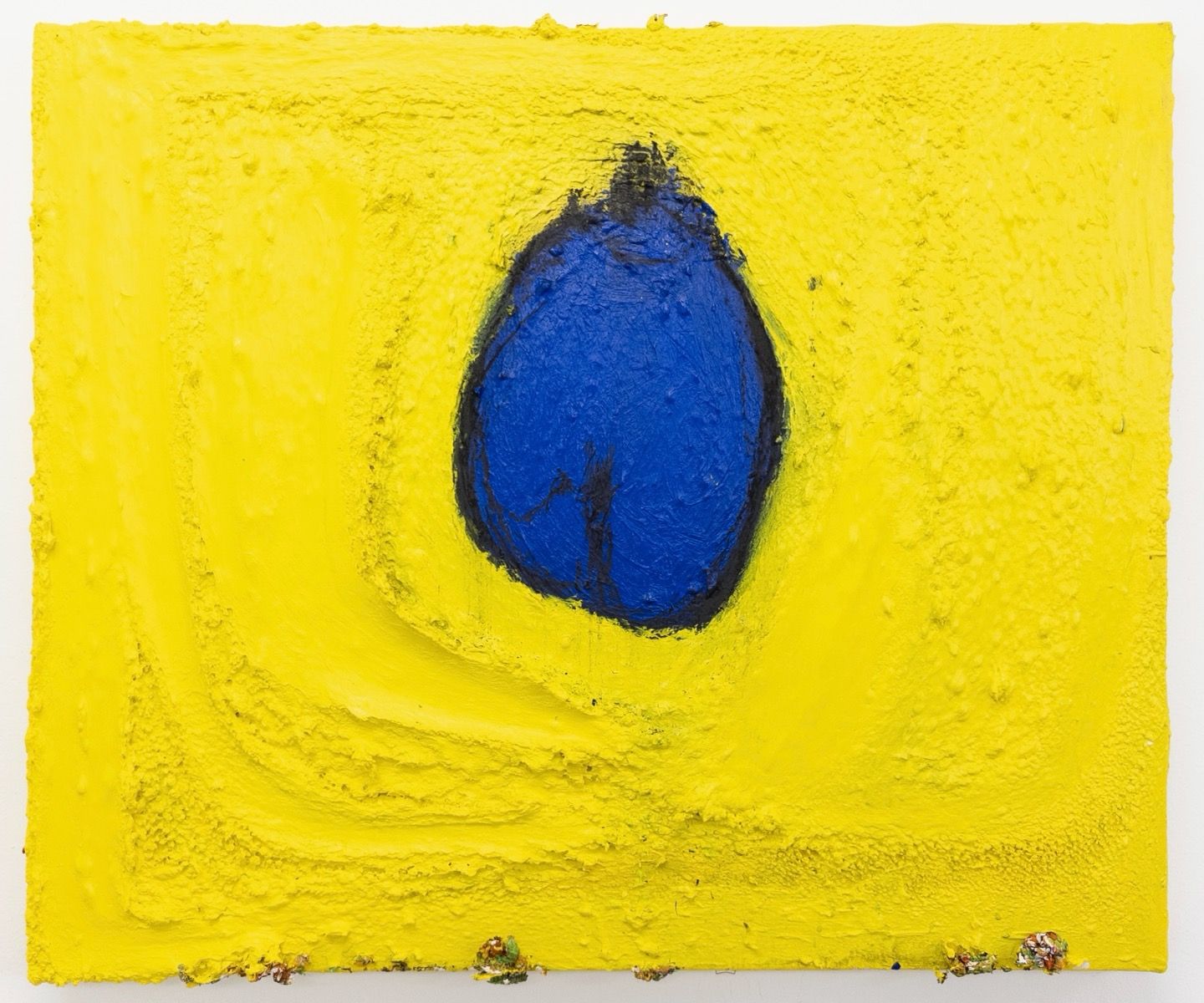
    In his early works, Oe filled the canvas with charming, energetic animals. He boldly sketched their forms in charcoal and layered colors with expressive brushwork, capturing their vitality as if directly transferring it onto the surface. Over time, he began switching the brush between his right and left hands, painting with strokes that showed no sign of physical fatigue. His paint grew thicker, and his work shifted toward an approach that seemed to play with the material itself. Then, following an event in January 2023*, his work developed into highly abstract paintings featuring a blue circle floating at the center of a yellow field, a series he continues to produce today. In his recent works, the paint builds up to such an extent that the very surface appears to grow outward, arriving at paintings that resemble living, growing organisms.

    *In 2023, at the row of three townhouses next to Atelier Hiko, the exhibition UPPALACE: A Palace of Leisure and Creation was held as a collaboration between the atelier members and visiting artists. It is said that a turning point in Oe's work came when an artist who had traveled from Oita stayed and worked just on the other side of the wall from Oe's workspace; from that moment, Oe's paintings suddenly shifted into abstract works composed of blue circles set against yellow backgrounds. Before this shift, there had been a moment captured in a large photographic work shown in the same exhibition (photographed by Ohtake Yosuke), in which Oe, painting a cat in yellow, pointed and said "kiiro" ("yellow").

    In this exhibition, we present late works from the animal series (around 2009–2020), the yellow Cat (2022), and the Yellow paintings (2023–2025). Through tracing the evolution of these works, we hope you will gain a sense of the creative wellspring that has sustained Oe's long engagement with painting.


    Biography

    1965 Born and lives in Osaka
    1978–1982 Attended the Dainenbutsu-ji Atelier
    1991–1997 Attended the Mizunoki Art Class once a week
    1995– Began working at Atelier Hiko, where he has continued to produce works actively

    Solo Exhibitions

    2014
    Oe Masahiko Exhibition, Nanakumo, Kyoto
    2009
    Oe Masahiko: Animal Paintings, Gallery horizont, Kyoto (also 2005)
    2004
    Oe Masahiko: ZOO-GRAPHIC Book Publication Commemorative Exhibition, Colon Books, Nagoya
    Oe Masahiko: ZOO-GRAPHIC, Osaka Prefectural Contemporary Art Center, Osaka

    Selected Group Exhibitions

    2025
    Kunisaki Peninsula Arts and Culture Festival, Kunisaki Peninsula Memory Museum (former Kunimi Youth Hostel), Oita
    PARALLEL UPPALACE: Playing With New Friends, or Perhaps a Mirage, The Three Traditional Japanese Row Houses, Osaka
    2024
    The Symbiosis Art Festival 2024: What Are You Doing Now?, Kyoto City Museum of Art Annex, Kyoto
    Relationship with Letters, The Three Traditional Japanese Row Houses, Osaka
    Beyond Yellow Yellow: Oe Masahiko & Ohtake Yosuke, The Three Traditional Japanese Row Houses, Osaka
    2023
    UPPALACE: A Palace of Leisure and Creation, The Three Traditional Japanese Row Houses, Osaka
    2016
    TORA, Gallery ten, Chiba
    2015
    Stillness and Motion: Mitoma Osamu & Oe Masahiko, Gallery ten, Chiba
    2014
    Outsider Art Fair, exhibited by Yukiko Koide Presents, New York, USA
    2011
    Daily Writing, Daily Drawing: Matsumoto Kunizo & Oe Masahiko, Amane-dō Gallery, Osaka
    The Museum of Everything Exhibition #4, London, UK
    2003
    DOWN TO ART: Artists with Down Syndrome, Sumida Riverside Hall Gallery, Tokyo
    2001
    Super Pure Exhibition 2001, Yokohama Civic Art Gallery and other venues, Kanagawa
    1999
    Art to Revitalize– Able Art '99, Tokyo Metropolitan Art Museum, Tokyo

    Collection

    The Museum of Everything (U.K.)

  • Untitled

    Katsunobu

    Katsunobu

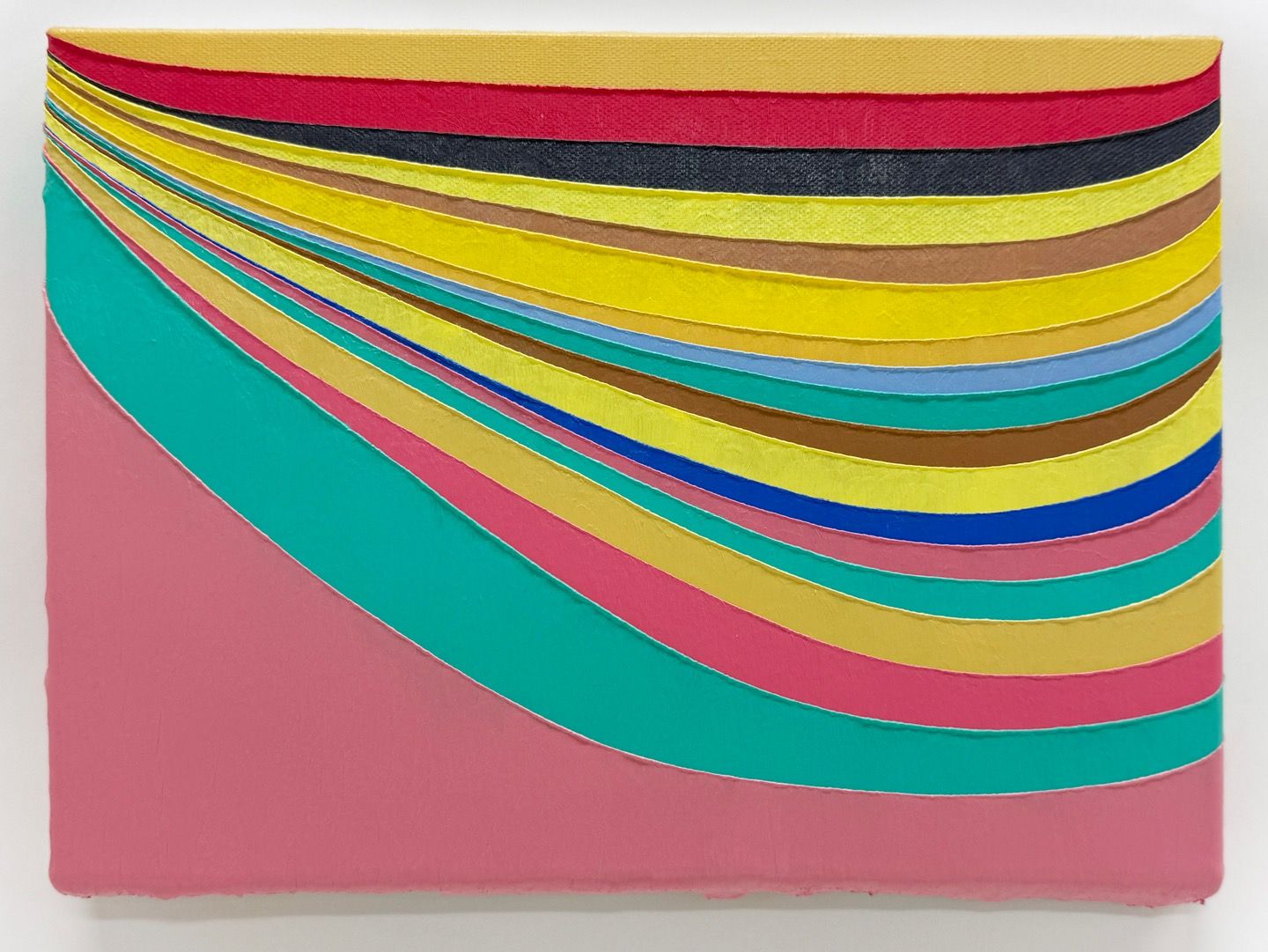
    Katsunobu creates abstract paintings of vivid color by building up multiple layers of oil paint. In 2006, when he was 14 years old and a second-year junior high school student, he began attending an art class. There, after mixing yellow and blue to make green, he was so astonished that he reportedly stared at the paint for some time. That first experience with color mixing became the starting point for what has now been nearly twenty years of painting color-field works in oil.

    In the beginning, he created abstract paintings with beautifully textured surfaces featuring overlapping rectangles, but around 2017 he shifted to producing his border-themed works. In this series, he loads the brush and pulls it downward; once he reaches the bottom edge of the canvas, he moves to the adjacent column and again pulls the brush downward, repeating this process to build up layers of paint. When he has worked all the way across the surface horizontally, he starts again from a slightly lower position on the canvas and repeats the same process. The horizontal bands that appear as borders are actually formed by countless vertical strokes laid side by side, and the layers of paint left on the edges and the drips that accumulate along the lower edge evoke the process through which the works are made.

    Having discovered color mixing and becoming captivated by color, Katsunobu has spent years pursuing the landscapes of color he envisions. Each day he carefully blends his pigments and continues to build up layers of paint. He works on multiple pieces at the same time, and it is said that completing a single work can take more than a year.
    Within this seemingly simple act lies the joy of working with color, the delicate and warm forms born from skilled hands, a sense of substance that gives the work its presence, and the richness of time itself. What emerges from this process are paintings that are truly one of a kind, created through Katsunobu's sincere dedication to his own way of method.


    Biography

    1992 Born and lives in Osaka
    2006 Began attending art class as a junior high school student (age 14)

    Solo Exhibitions

    2022
    Katsunobu, Tomio Koyama Gallery Tennoz, Tokyo
    2018
    Gallery Ami Kanoko, Osaka (also 2017 and 2016)

    Selected Group Exhibitions

    2025
    Art to Live Exhibition: Empowering Society Through Art, Gallery WEST, Expo 2025, Osaka
    Outsider Art Directions: Westerly Winds from Osaka, Fukagawa Tokyo Modan Kan, Tokyo
    2017
    capacious Exhibition #06: What you call "special" maight be what I call "usual". , Enokojima Art, Culture and Creative Center [enoco], Osaka
    2016
    Kaji Hidetaka/Takayama Katsunobu, Gallery Ami Kanoko, Osaka
    LIFE ART 2016 - Art by ripehouse Artists, Contemporary Art Space Osaka (CASO), Osaka
    MY WAY YOUR WAY: You'll Understand If You Go; Go Without Hesitation, Ryukoku University, Seta Campus, Shiga
    2015
    Spirits / The Wind of ripehouse: The Wonderful ripehouse Artists, Kurayoshi Art Museum Mushin / Yonago Convention Center, Tottori
    Korea–China–Japan: Artists with Disabilities, Seogwipo Art Exhibition Hall, Seogwipo, Jeju Island, South Korea
    2013
    The Beginning of Images: The marks of sparks, Gallery H.O.T, Osaka
    2011
    LIFE ART, Contemporary Art Space Osaka (CASO), Osaka

  • Untitled

    Katsuyama Naoto

    Katsuyama Naoto

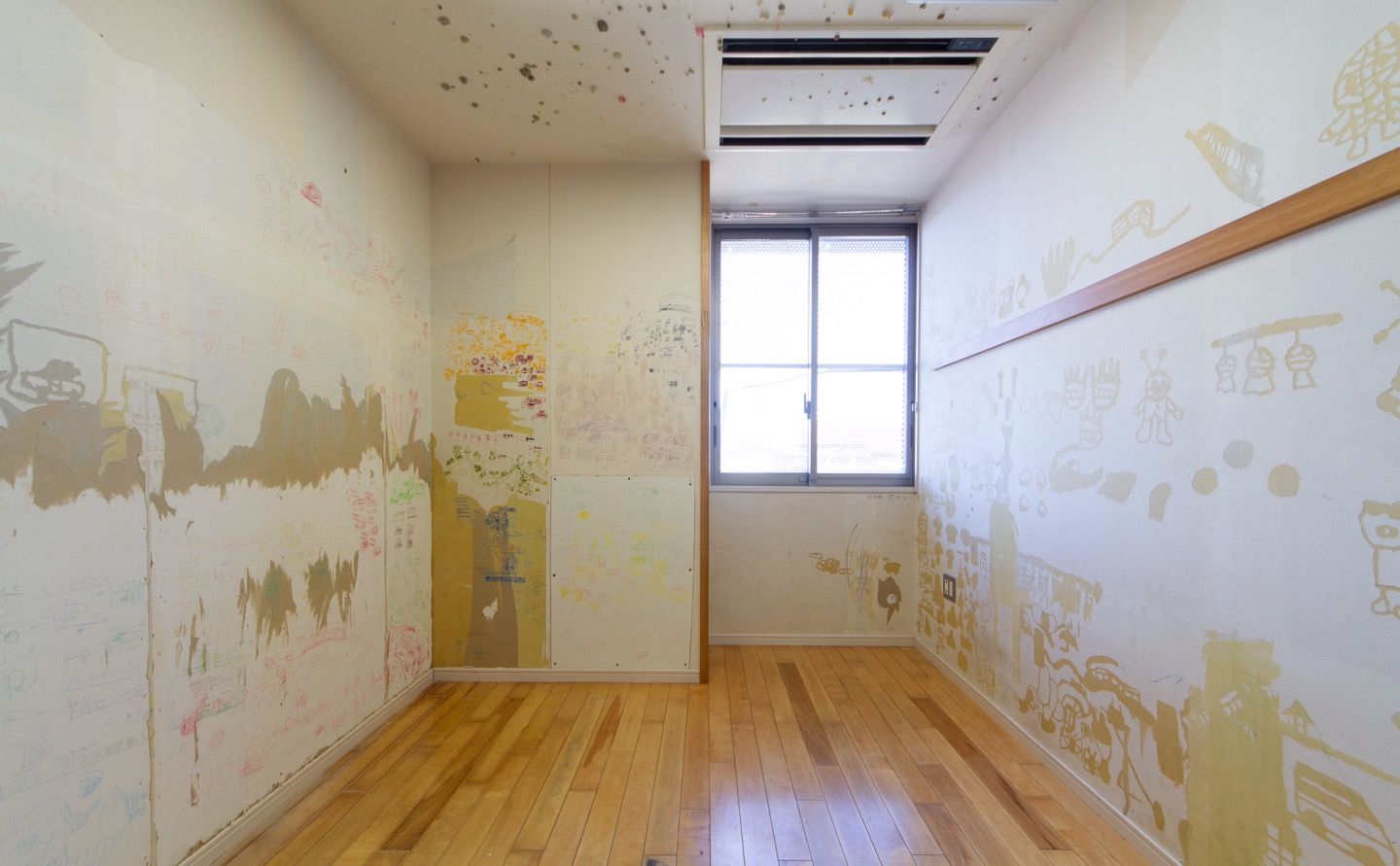
    Katsuyama Naoto's wall drawings originated when he was in the fifth or sixth grade of elementary school, during a period of isolation while recovering from influenza. Even without art materials at hand, he continued to draw with determination, using a method he devised himself: moistening the wallpaper with saliva so that he could peel it away.

    Although tearing the wallpaper could easily have been regarded as property damage, the staff recognized it as an essential form of expression for him and responded sympathetically. After he later gained access to art materials, he began drawing the same motifs in pen over the areas where the wallpaper had been removed. Even now, in 2025, traces of these actions remain in three or four rooms at Kumi Gakuen, despite his having left the facility.
    Katsuyama would also put the torn wallpaper into his mouth, chew it like gum, and then throw it onto the ceiling so it would stick. Looking up, one sees countless bits of paper scattered across the ceiling, like a star-filled sky.

    Shut away in his private room, he continued peeling away the wallpaper and drawing murals on the walls, as well as sticking chewed bits of paper onto the ceiling. These acts were not done for anyone to see; they were forms of expression nurtured in solitude, complete in themselves. Yet it was through the attentive eyes of his caregivers that this practice was recognized, leading to its introduction to the world today.

    What thoughts filled his mind as he sat surrounded by his favorite motifs, gazing up at the ceiling? The traces Katsuyama left behind invite viewers into a rich realm of imagination.


    Biography

    2006 Born and lives in Saitama
    2009-2025 Lived at Kumi Gakuen, a welfare-based residential facility for children with disabilities, from the age of 3 to 18
    2025 Currently engages in daytime artistic practice at Kōbō-shū

    Group Exhibitions

    2021
    The Symbiosis Art Festival 2021: Going on a Trip, Getting Ready, Kyoto City Museum of Art Annex, Kyoto
    12th Saitama Prefectural Art Exhibition for Artists with Disabilities: LOOK ART ME!!, The Museum of Modern Art, Saitama
    2020
    Under a Sky Full of Stars, the Raw Gems of Creativity Also Shine: Changing, Transforming, an Expanding World, Tokyo Shibuya Koen-dori Gallery, Tokyo
    Gaze Radio in Geigeki, Tokyo Metropolitan Theatre, Gallery 2, Tokyo
    2019
    10th Saitama Prefecture Art Exhibition for Artists with Disabilities: knock art 10 Art Has No Weight Class, The Museum of Modern Art, Saitama
    2018
    9th Saitama Prefectural Art Exhibition for Artists with Disabilities: Sonic Boom, HeHe, Sonic City, Saitama
  • Untitled

    Saito Aya

    Saito Aya

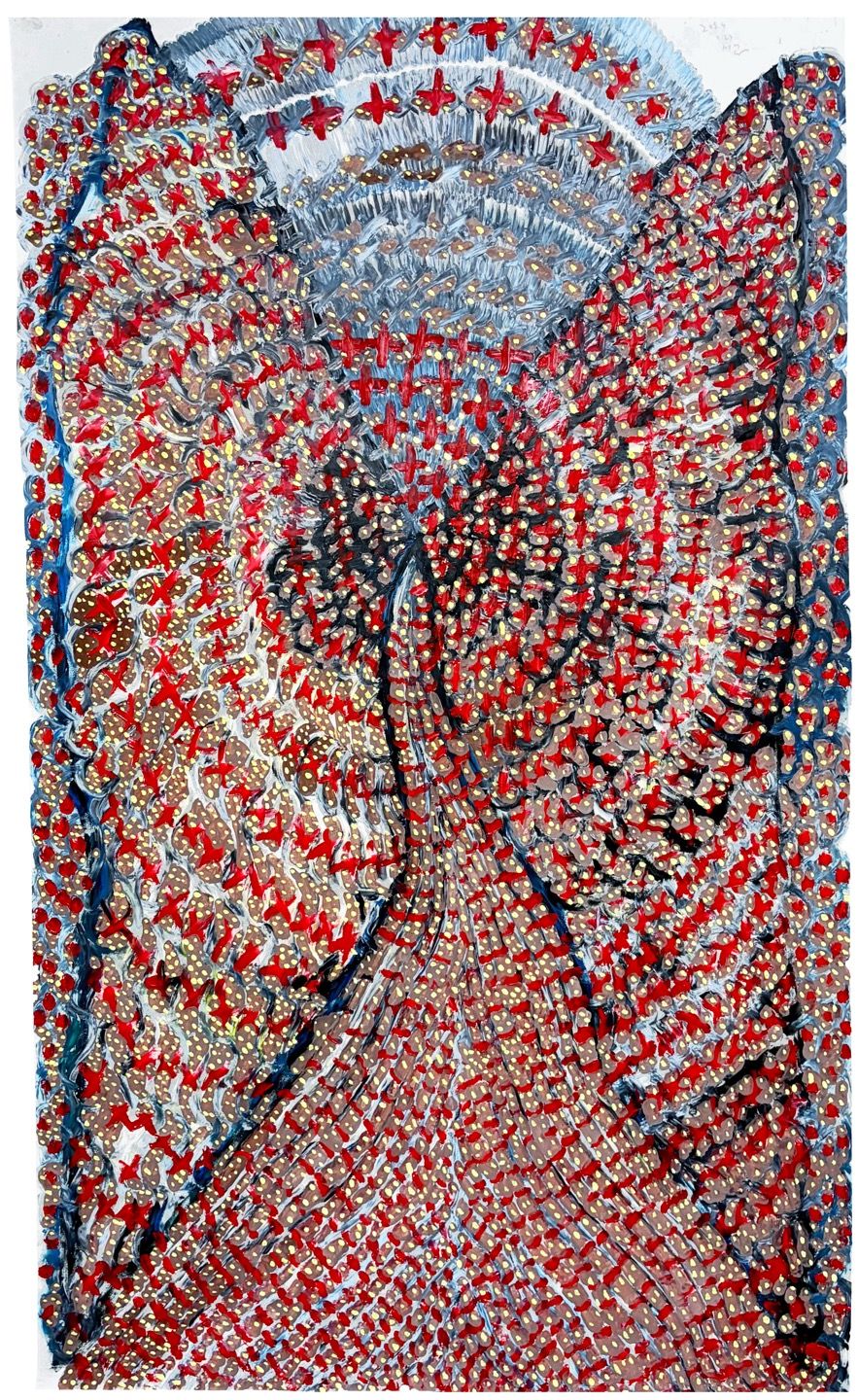
    Saito Aya creates emotive paintings brimming with vital energy. When asked about the themes or motifs in her work, she doesn't say much, simply replying, "It really isn't something I can put into words, I just want to draw."
    On the canvas, silhouettes of faces and dolls, sensory organs such as eyes and ears, plant and animal-like tentacles, and forms reminiscent of cells or spores are composed organically, creating a rich and varied field of imagery. Her working process is also distinctive: while she mainly uses oil paint (occasionally combined with acrylic, ink, pencil, or crayon), she applies the paint directly with her fingertips and palms, a highly physical method of painting.

    The landscapes of the place where the artist was born and raised, along with the accumulation of experiences she has encountered throughout her life, seem to be deeply etched into her sensibility and body, guiding the paper and paint through her fingertips. At the same time, her brushmarks evoke something that transcends personal memory and experience, and at times it can seem as if the very pulse of the earth is emerging onto the canvas through her body as its conduit.

    The works for this exhibition were selected from a small number of highly abstract pieces. By creating distance from the concrete meanings of recognizable forms, we hope viewers will sense the pulse and breath that reside within Saito Aya's paintings through their rich colors and complex brushwork.


    Biography

    1981 Born in Tokyo, currently lives in Kanagawa
    2003 Graduated from Joshibi University of Art and Design, Department of Western Painting

    Solo Exhibitions

    2025
    Wandering Paintings: Saito Aya, Galerie Miyawaki, Kyoto
    A Woman on a Certain Day, iTohen Gallery Books Coffee, Osaka
    2024
    Saito Aya: The Artwork-Naming Project — Reading Paintings: Do Titles Matter?, Nagai Gallery, Tokyo
    2022
    Saito Aya 2022, Kyotoba, Kyoto
    2021
    Nike Curators Selection #5: Saito Aya, Galleria Nike, Suginami Campus, Joshibi University of Art and Design, Tokyo
    2015
    Saito Aya: 2003–2015, Yokohama Civic Art Gallery Azamino, Kanagawa

    Group Exhibitions

    2025
    Joshibi University of Art and Design 125th Anniversary Exhibition: Cultivated Talents from Meiji to Reiwa, Nihombashi Mitsukoshi, Tokyo
    2022
    Collection 2022 – Autumn/Winter: Tanaka Tsuneko Collection, The Museum of Modern Art, Wakayama
    Saito Aya & Nakayashiki Tomonari: Walking — Time That Cultivates the Memories of Wandering, Galerie Miyawaki, Kyoto
    2021
    Saito Aya & Nakayashiki Tomonari: Walking — The Intersection of Sensation and Thought, Musashino Art University, Takanodai Campus, Tokyo
    2018
    The Takahashi Collection: Faces and Abstraction, Kiyoharu Art Colony, Yamanashi
    2009
    Daido Moriyama: Record – on the road collaboration with 8 creators, Epson Imaging Gallery epSITE, Tokyo

    Awards

    2008
    Color Imaging Contest – Katsui Mitsuo Award
    2005
    25th Graphic Art Hitotsubo Exhibition – Grand Prize
    2004
    1st Foil Magazine Award – Grand Prize
    GEISAI 5 – Nara Yoshitomo Award

    Public Collection

    Joshibi Art Museum, Joshibi University of Art and Design / Takahashi Ryutaro Collection / The Museum of Modern Art, Wakayama


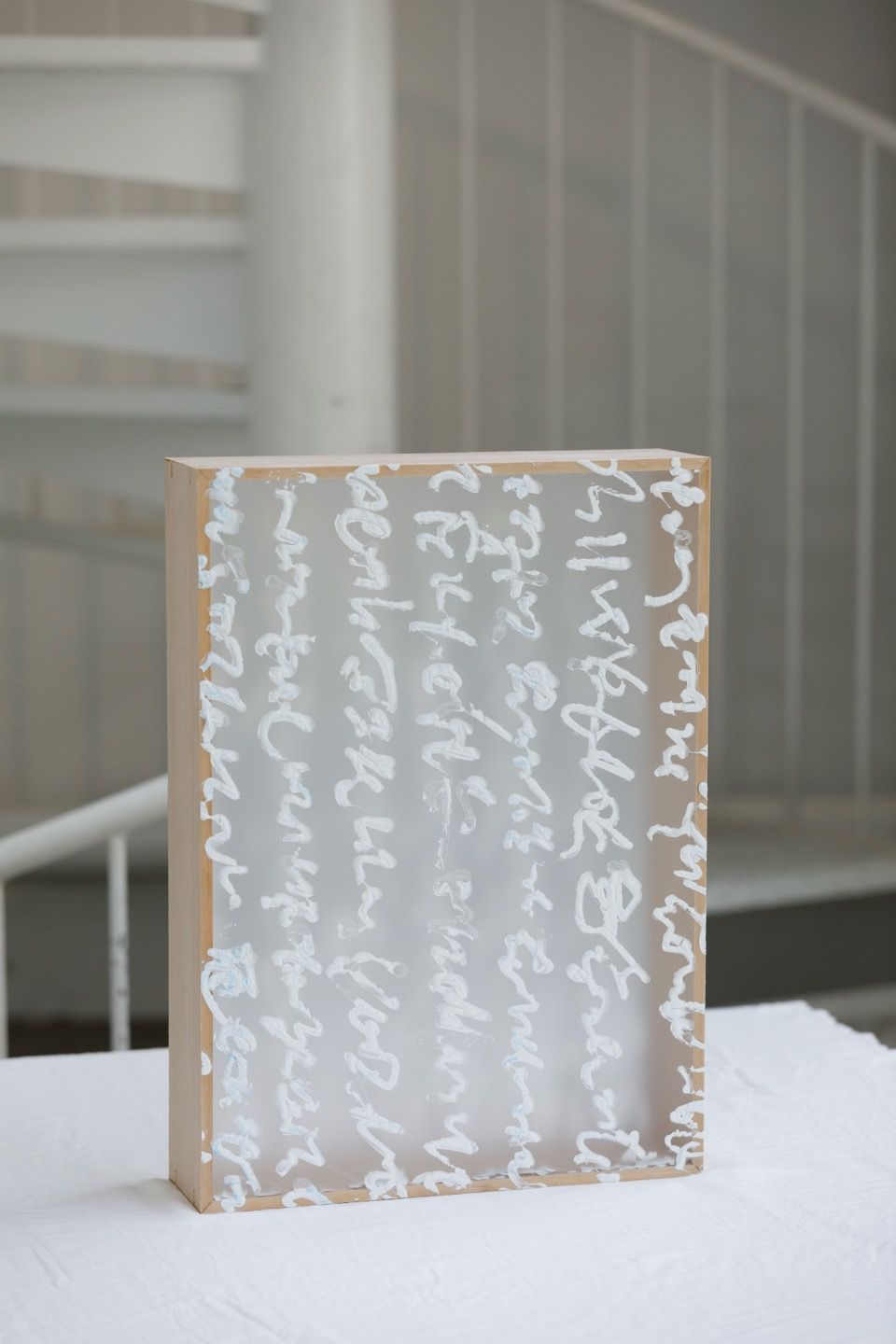
  • Be born while broken (a word full of mistakes) 1

    Takada Mal

    Takada Mal

    Takada Mal centers her practice on a fundamental question: "Why do humans still feel compelled to create drawings, show drawings, and look at drawings?" She leads her own painting reviewing group and actively pursues this inquiry through group exhibitions and dialogue-based projects with fellow contemporary artists.

    "In exploring the primal impulses and desires that drive humans toward painting, I approach 'painting' not as a physical or material form, but as an event that unfolds between people. Through practice, I consider what happens within deeply personal acts of depiction and description, and within their transmission and misreading in public settings. While the discourse surrounding 'painting' continually shifts, the act of painting itself remains endlessly and profoundly private. Precisely because it is private, it possesses both fragility and strength. I continue to engage with paintings that are born—and broken—through encounters with others."

    —Artist Statement

    In this exhibition, Takada presents two bodies of work. The first is the Wall Drawings series, in which small pencil sketches, drawn in her diary as records of everyday moments when her "eyes met" something or when she "shared a moment in time" with it, are expanded into murals. In these works, the drawings rise into being within a public space, transform into images as perceived by the viewer, and ultimately contain within them the process of their own disappearance. The second is the Be born while broken (a word full of mistakes) series, in which lines that waver between legibility and illegibility resemble strings of text, highlighting the very act of drawing/writing itself.

    By engaging with "painting as an event," in which the sketches and not-quite-words that once belonged solely to a private diary are transformed through encounters with others, we are prompted to rethink how we share space and time, and how those experiences take shape as memory.


    Biography

    1987 Born in Kanagawa, currently lives in Osaka
    2009 Japan Women's University, Faculty of Arts and Letters, Department of History, Major in Religious Studies
    2012-2015 Completed multiple courses at Bigakko
    2024 MA, Master's course, Department of Oil Painting, Graduate School of Arts, Kyoto City University of Arts

    Solo Exhibitions

    2025
    When diaries become letters What's born is you The giant you never knew is a friend, VOU, Kyoto
    2024
    This flower, dahlia, Dahlia, DAHLIA, NADiff Window Gallery, Tokyo
    2023
    Advancing Lines, Morning Greetings, JITSUZAISEI, Osaka
    2022
    The Prayers are in Their Usual Form Today, soko station 146, Tokyo
    I Keep Praying in a Language I Don't Know, NADiff Window Gallery, Tokyo

    Recent Group Exhibitions

    2024
    Window Gallery in Marunouchi ― from AATM vol.2, Gyoko-dori Underground Gallery, Tokyo
    Art Rhizome KYOTO 2024 ― Kyoto Wander: A Transient Journey to the Everlasting, Kyoto City Hall Annex, Kyoto
    Related Program for the Centenary Exhibition Commemorating the 100th Anniversary of Shiraga Kazuo's Birth: Jogyo Zanmai, A-LAB, Hyoto

    Publications

    2024
    Co-authored with Takada Mal and Endo Yusuke, .xyz/provoked, paper company
    Edited volume, Prayers as Lines Moving Forward, Morning Greetings of the Same Shape as Today, KAIGA-reviewing strata
    2022
    Edited volume, Unforgettable Stories of Paintings: KAIGA reviewing session 2020-2021, KAIGA-reviewing strata
    2020
    Edited volume, Painter of the 21st Century, The Initial Impulse of a Testament: KAIGA reviewing session 2018, KAIGA-reviewing strata

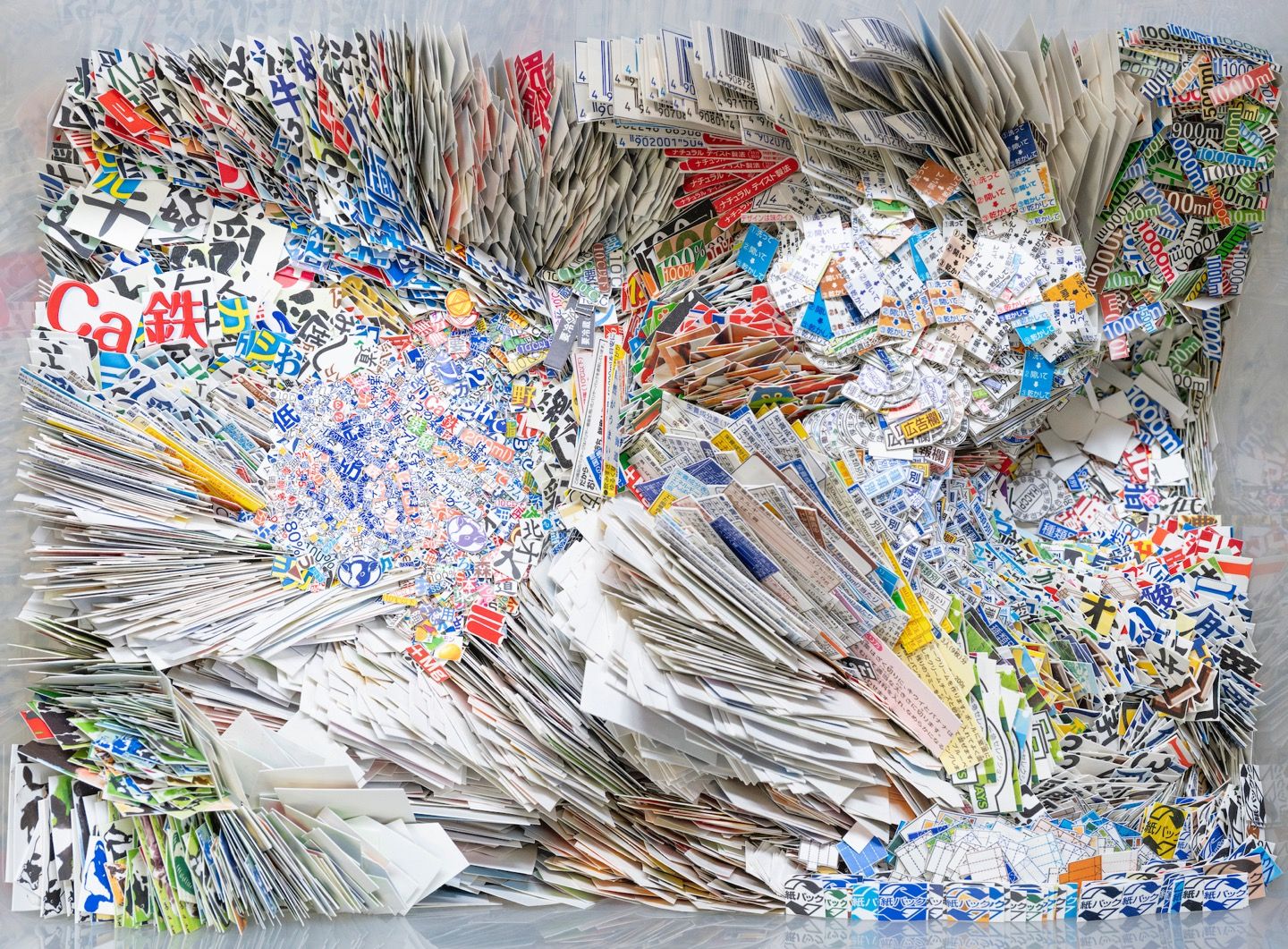
  • Milk carton

    Nakane Kyoko

    Milk carton

    2014- in progress
    Size varies
    Documentation photo taken in 2025

    Nakane Kyoko

    Nakane Kyoko has, since around 2014, been cutting milk cartons into small pieces with scissors and stacking those fragments inside plastic storage cases. She slowly cuts out printed product logos, ingredient lists, nutrition facts, graphics, characters, barcodes, and more, carefully placing each piece one by one and meticulously arranging them within each case. Because the paper fragments are not adhered to one another, they are fragile and easily disturbed by vibration. Toward the bottom and along the sides of the cases, they collapse like an avalanche, forming organic, stratified layers. The continuously accumulating pieces subtly change day by day, revealing a complex surface texture. Occasionally, letters are cut out one by one and lined up along barcode lines, which becomes a striking visual highlight of her work.

    This action, which cannot be preserved as a tangible object, has continued for over ten years as far as we can confirm, during which support staff and exhibition organizers have periodically documented it.
    The documenting photographs on display at this time show approximately nine months of change, from March to December 2025.


    Biography

    1984 Born and Lives in Osaka
    2008 Began attending Work Center Toyonaka
    2014- Continues to work on cutting milk cartons into small pieces and layering them inside plastic storage cases

    Group Exhibitions

    2025
    Art to Live Exhibition: Empowering Society Through Art, Gallery WEST, EXPO 2025, Osaka
    2024
    Repeat and Accumulate 2 Sense of Wonder, Enokojima Art, Culture and Creative Center [enoco], Osaka
    2019
    The Symbiosis Art Festival: "DOUBLES", Kyoto Institute, Library and Archives, Kyoto
    2017
    capacious Exhibition #06: What you call "special" maight be what I call "usual"., Enokojima Art, Culture and Creative Center [enoco], Osaka

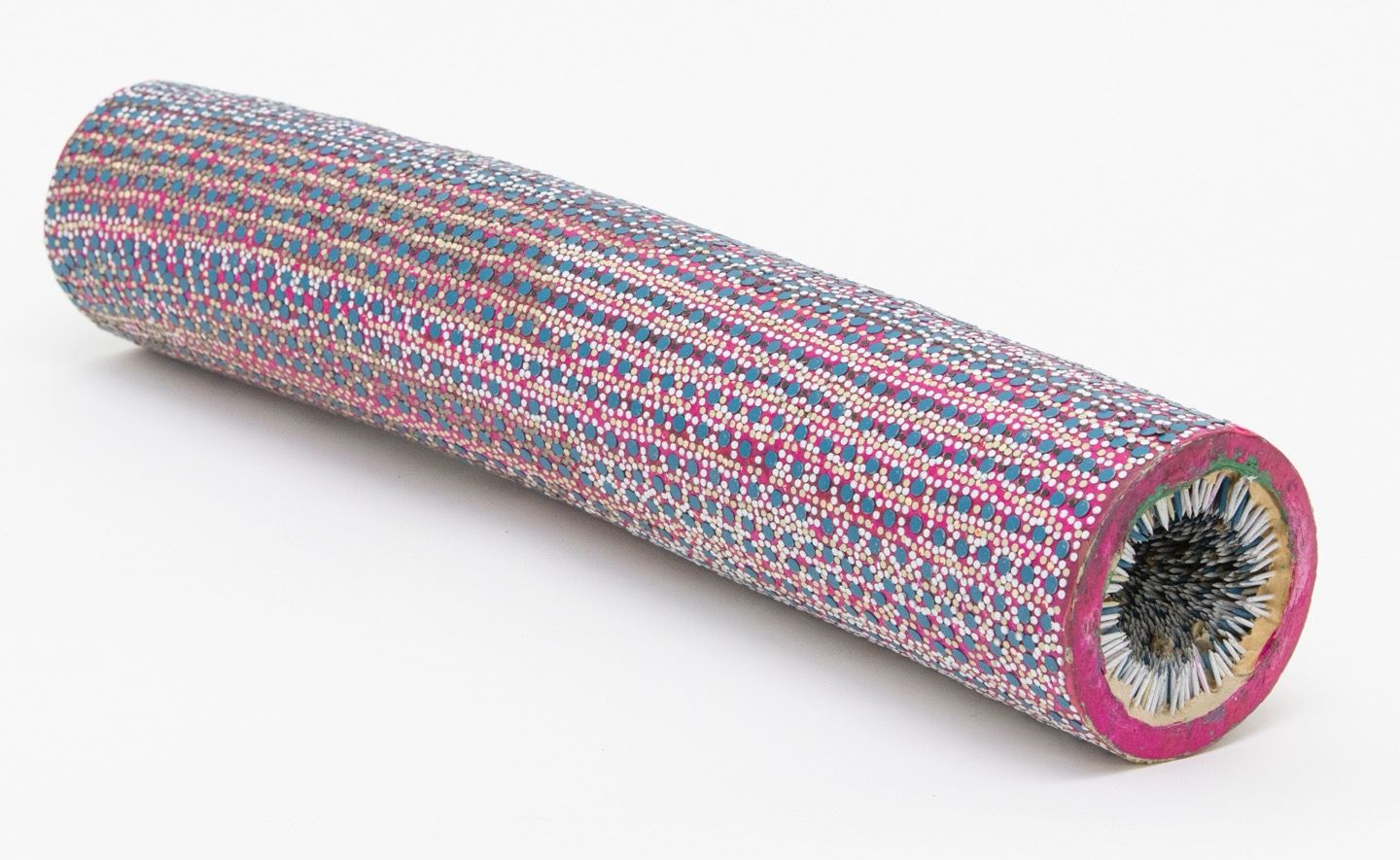
  • Corn on the cob

    Hirata Yasuhiro

    Hirata Yasuhiro

    Hirata Yasuhiro was born into a family that ran a construction business, and from a young age he spent his time watching his father at work in the carpentry shop. When he first began attending the art studio, he repeatedly painted sideways portraits of people as well as his father's work tools, such as caulking guns, nails, and paint cans.

    Hirata began creating cylindrical objects around 2004, a time of significant personal change, including his graduation from the familiar environment of his special-needs school and the loss of his grandmother—the first time he experienced the death of a close family member. This shift in his artistic focus was prompted when his father happened to receive a paper tube from a business acquaintance.

    Hirata drives countless nails into an unstable curved surface, placing them at regular intervals, and then draws spirals or circles around them. According to him, he is recreating his favorite food, which is corn. Hammering nails into the curved surface requires a high level of skill, a technique he mastered from a young age when he became adept at using a hammer. He continuously strikes the nails with precision, working his way towards the center of the cylinder. Hirata immersed himself in the creation of these "corn" objects for about ten years, and after that, his practice continued at a relaxed pace, with him striking one or two nails per day.
    Hirata resumed his intense focus on creating the "corn" sculptures around 2020, when the state of emergency of the COVID-19 pandemic was declared. In recent years, he has incorporated a variety of nails, covering the entire surface of the paper tubes so densely that it is almost completely covered.

    From Hirata's works, where nails are driven in single-mindedly, a profound spirituality emanates that can be felt as either madness or prayer.


    Biography

    1984 Born and lives in Osaka
    1998 Started working at Atelier Hiko in his second year of junior high school, currently works there once a week

    Solo Exhibition

    2022
    Capacious Exhibition#17: Y asuhiro Hirata Solo Exhibition, Calo Bookshop and Cafe, Osaka

    Recent Group Exhibitions

    2025
    Art to Live Exhibition: Empowering Society Through Art, Gallery WEST, EXPO 2025, Osaka
    Exploring Ⅱ - Fragments of Art in Everyday Life -, Spiral Garden, Tokyo
    2024
    Relationship with Letters, Atelier Hiko and the Three Traditional Japanese Row Houses, Osaka
    2023
    Uppalace ~The Palace of Leisure and Creation~, Atelier Hiko and the Three Traditional Japanese Row Houses, Osaka
    2021
    Outsider Art Fair's Special Exhibition: Super-Rough, Guest curated by Takashi Murakami, SoHo, New York, U.S.A.

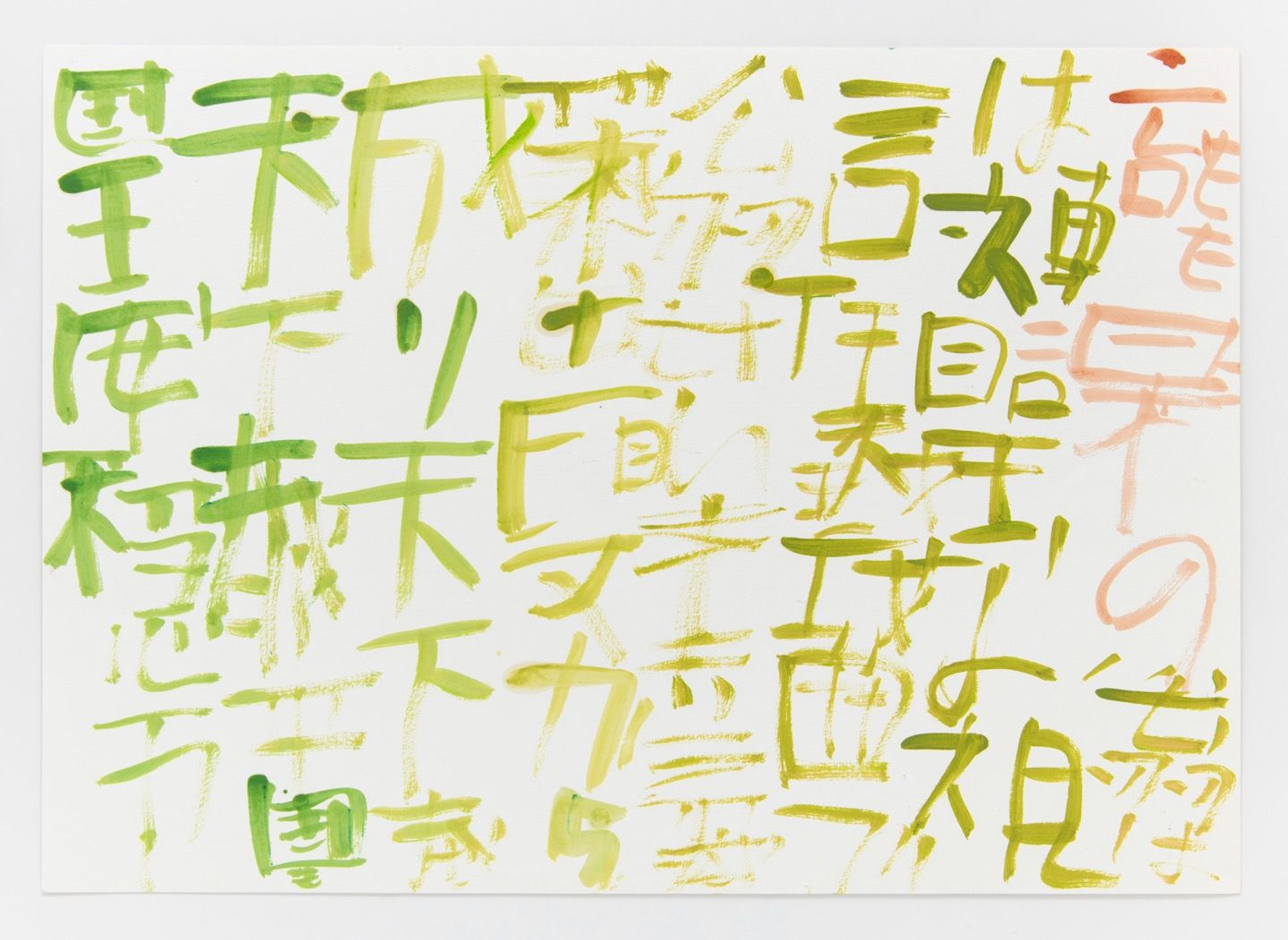
  • Noh Play Okina Is...

    Matsumoto Kunizo

    Matsumoto Kunizo

    Matsumoto creates works by densely layering his distinctive writing on items like calendars, notebooks, and letters. The characters featured in his works are closely tied to the environment in which he grew up. Among these, kanji characters such as "舞" (dance), "男" (man), "女" (woman), "鬼" (demon), "火" (fire), and "命" (life) appear repeatedly. This style took shape from early kabuki-viewing experiences beginning at age three, through calligraphy lessons at school and local facilities, and later through self-taught copywork using the pamphlets he collected, all of which gradually formed his own unique world of characters.

    The works written in brush and ink date from around 2000, when Matsumoto was in his middle years. As a child, he often persuaded his father to take him to the Kabuki-za and the Bunraku Theater, where he eagerly purchased catalogues at every visit. After he began attending Atelier Hiko, he spent one day each week on what he called "excursions," traveling to scenic sites throughout the Kansai region, always intent on collecting flyers wherever he went. Immersing himself in this vast archive of printed materials, he repeatedly copied out characters that caught his attention; in the process, the radicals within kanji became broken apart and reassembled, gradually transforming into his own unique set of characters.

    The works presented here, Noh Theater Okina, Final Act: Nagamachi Ura (the Back Lane at Nagamachi), and Kōbaian Teahouse, each convey his deep admiration for Noh, Kabuki, and the tea ceremony. The accompanying memo works were created night after night at home after the sudden passing of his beloved father, during a period when he immersed himself in writing as a way of filling the absence left behind.

    When we interpret Matsumoto's uniquely invented world of characters in relation to the paper he used, the density of the writing, and the period in which they were made, his life story begins to emerge.


    Biography

    1962 Born and lives in Osaka
    1985 Writing characters became part of his daily routine
    1988-2016 Helped out at his family's Chinese restaurant
    1995 Started attending Atelier Hiko

    Solo Exhibitions

    2007
    Galerie Susanne Zander, Cologne, Germany
    Obsessed with Letters, Yukiko Koide Presents, Tokyo
    2004
    Obsessed with Letters, Yukiko Koide Presents, Tokyo

    Recent Group Exhibitions

    2025
    Art Brut. The privacy of a collection. The Decharme donation to the Centre Pompidou, Grand Palais, Paris, France
    Art to Live Exhibition: Empowering Society Through Art, Gallery WEST, EXPO 2025, Osaka
    Exploring Ⅱ - Fragments of Art in Everyday Life -, Spiral Garden, Tokyo
    2024
    Relationship with Letters, Atelier Hiko and the Three Traditional Japanese Row Houses, Osaka
    2022
    Do the Write Thing: read between the lines #3, Christian Berst, Paris, France
    2021
    Letters -Tangling Unraveling-, Tokyo Shibuya Koen-dori Gallery, Tokyo
    2020
    Scrivere Disegnando, When language Seeks Its Other, Centre d'Art Contemporain, Geneva, Switzerland
    2018
    Do the Write Thing: read between the lines #2, Christian Berst, Paris, France
    2016-2017
    The Museum of Everything Exhibition #7, Museum of Old and New Art, Tasmania, Australia
    2015
    Art Brut Live: Collection abcd / Bruno Decharme, DOX Center for Contemporary Art, Prague, Czech Republic
    2014-2015
    Art Brut Live: Collection abcd / Bruno Decharme, La Maison Rouge, Paris, France

    Public Collection

    Musée National d'Art Moderne - Centre Pompidou (France) / Collection de l'Art Brut (Switzerland) / The Museum of Everything (U.K.)


  • granite (L)

    Morimoto Eri

    Morimoto Eri

    Morimoto creates paintings and sculptures using a systematic method based on specific rules. It gives a complex impression, as if emotions and sentiments have been eliminated, but in reality, it is a record of deeply personal sensations and actions. The artist says that she is strongly drawn to fractal patterns, boundaries, and net-like structures. She separates concrete sensations like humidity, the scent of the environment, and the joy of looking at beautiful plants and landscapes, reconfiguring them into artwork through her unique filter.

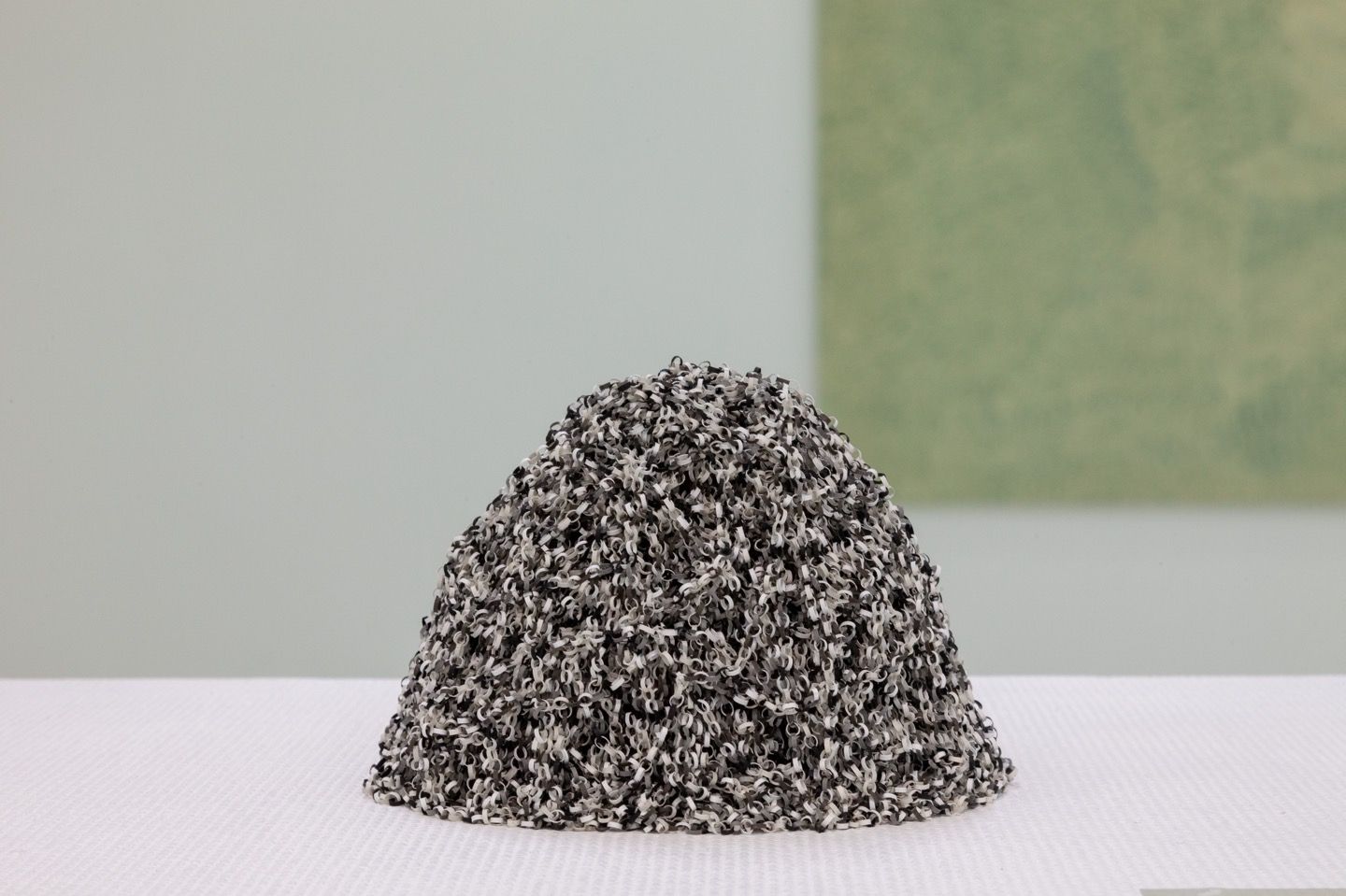
    The series of flat works titled contour map is based on landscapes that the artist found compelling. These landscapes are deconstructed into dots of various colors and sizes, and after calculating the dimensions, the artist then places these dots on the canvas according to a predetermined plan, creating the final piece. The paired "memo" serves as a manual documenting the production process (which the artist refers to as a "recipe"). It details the number of dots for each color and the process of placing them, with each unit of the cross-shaped pattern representing 100 dots. In this exhibition, we present recent works inspired by a sandy beach from an area that is personally meaningful to the artist. Morimoto has been cutting paper into fine pieces with scissors since the age of four or five, a practice she has continued as a lifelong pursuit for over forty years. The three-dimensional work Granite (Large) on view is an extension of this practice: following her own set of rules, she cuts 1×10 mm strips of paper and forms minuscule paper rings, which are then linked together like a chain to create the piece.

    The uniform placement of perfect circles mere millimeters apart, and the linking of countless tiny paper fragments into exquisitely formed rings, demands a process and mastery of technique that defies imagination. The artist describes this repetitive act by saying, "Though it brings physical pain, it is the mind that finds peace and fulfillment." The childhood experience of cutting paper, refined through many years of practice, has evolved into the foundation of Morimoto's artistic expression. Her works, born of exceptional craftsmanship and a gentle rhythm, offer viewers both a sense of wonder and a completely new visual experience.


    Biography

    1978 Born and lives in Osaka
    2003 MA, Master's course, Department of Painting, Graduate School of Arts, Kyoto City University of Arts

    Selected Solo Exhibitions

    2024
    Contour Map♯ -from the beginning-, Gallery Yamaki Fine Art, Hyogo
    2020
    Conversion by Example, SAI Gallery, Osaka (also 2010 and 2007)
    2007
    Eri Morimoto, SAI Gallery, Osaka
    2004
    CRITERIUM 58, Art Tower Mito, Ibaraki
    2002
    The Time of Blooming, Gallery 16, Kyoto

    Selected Group Exhibitions

    2025
    Exploring Ⅱ - Fragments of Art in Everyday Life -, Spiral Garden, Tokyo
    2024
    Here and There and Back Again, Japanese Art 1964 – 2024, Nicolas Krupp Gallery, Basel, Switzerland
    2023
    ABSTRACTION ‐The Possibilities of Painting‐, Gallery Yamaki Fine Art, Hyogo
    2012
    Art Picnic vol.2 breathing art, Ashiya City Museum of Art and History, Hyogo
    2008
    VOCA 2008 -The Vision of Contemporary Art-, The Ueno Royal Museum, Tokyo
    2003
    Kobe Art Annual 2003 Grip the Gap, Kobe Art Village Center, Hyogo

Access

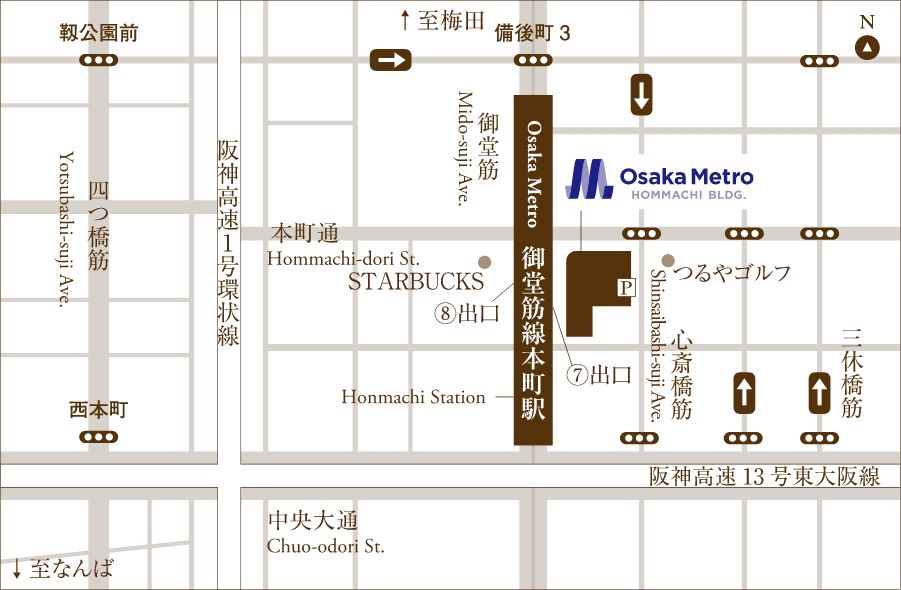
Osaka Metro Hommachi Bldg. 1F

3-6-4 Hommachi, Chuo-ku, Osaka 541-0053 Japan

Direct access from Osaka Metro “Hommachi” Station Exit 7

  • Please enter the building from the underground passage near Exit 7, then take the escalator or elevator up to the ground floor (1F).
  • If using the elevator, please transfer between the two — one on the ticket gate level and one on the underground passage level — to reach the venue.
  • If you require any assistance or special arrangements, please contact the Art to Live Office in advance.
Access map to Osaka Metro Hommachi Bldg. 1F